The Glue-Up Planner
The PerBond planner for buying, mixing and curing the adhesive a job really takes, not the geometric volume a calculator shows first
PerBond's Adhesive Coverage Calculator gives the geometric volume of a bond and says to buy a margin over it; the Coverage per Cartridge Calculator says real yield is a little lower than its answer. Neither says how much, and the two never meet. Neither counts what every mix throws away, or the batch size the Epoxy Mix Ratio Calculator warns about. The Glue-Up Planner is the rest of the count. Part 1 lists every bond, takes the glue line from the data sheet and measures your own waste. Part 2 counts the losses in every nozzle and mixing cup, prices each pack size for the whole job, splits it into batches under the pot-life limit and plans the cure at your shop's temperature. The worked example, a 120 x 60 cm panel and 4.8 m of fillet bead, is 351.72 mL on the calculator: one 400 mL kit, apparently. With 15% waste and five mixing cups it needs 419.48 mL, so that kit runs out in the last batch; the same job costs $126 in 50 mL cartridges and $72 in a 1,000 mL kit. Every figure is computed by the site's own calculators, and the job, losses and prices are examples you replace with your data sheet and your supplier's prices. It counts adhesive and never says what a joint will hold: load-bearing, overhead, vehicle and safety bonds go to the adhesive maker's data sheet and a qualified engineer, and the label's ventilation, gloves and eye protection come before the first mix. Included: 23 printable pages with a bond list, a buy sheet and a batch and cure log, plus a personalised sheet worked from the numbers you entered in the calculator.
Look inside
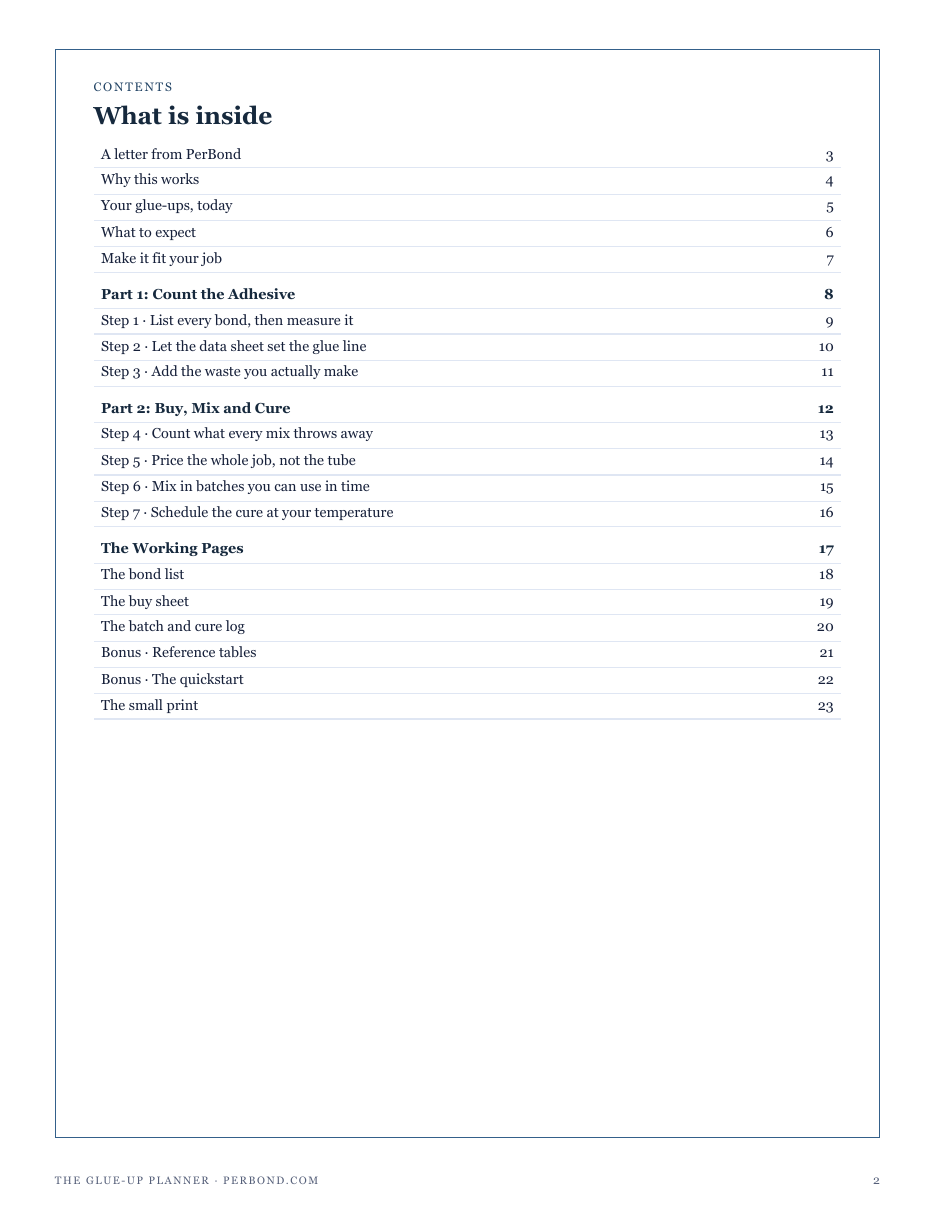
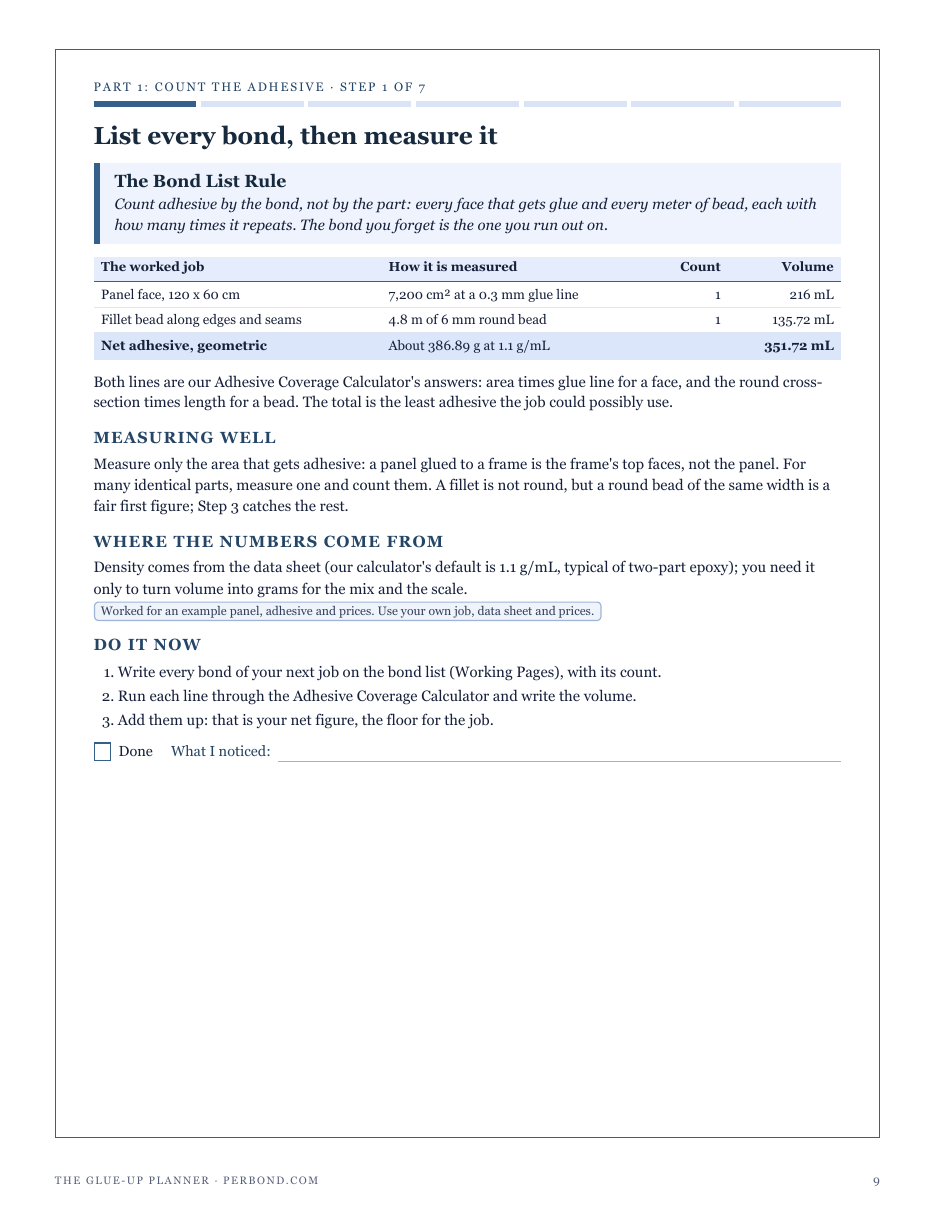
Two full pages from the planner, exactly as printed. Click either to read it at full size before you decide.
What is in it
- The bond list: every face and every meter of bead, with its count, run through the Adhesive Coverage Calculator
- The glue line from the data sheet, and why it is the biggest number in the count
- Your own waste, weighed once on a kitchen scale, in place of a guessed margin
- The losses in every mix: what a static-mixer nozzle and a mixing cup keep, counted per session and per batch
- Each pack size priced for the whole job, with the leftover and its shelf life, and why the free number runs short
- Equal batches at or under the pot-life mass, resin and hardener for each, with the label's ventilation, gloves and eye protection
- The cure at your shop's temperature, the three different times, and where the answer stops below 5 °C
- A bond list, a buy sheet and a batch and cure log to print
- Reference tables: mL per meter of bead and meters per cartridge, mL per square meter of glue line, cure multipliers
- A personalised sheet: your bond with waste and the packs to buy, your batches, or your cure time, from the calculator you used
- ✓ 23 printable pages
- ✓ 10 sections, worksheets and templates
- ✓ A second PDF worked out from the numbers you enter
- ✓ No account needed, just an email address
- ✓ Instant download; link valid 7 days
Price includes any taxes. Sold by GrabURL, who handle checkout and support. The charge appears on your statement as GrabURL.
The planner picks up where the free Adhesive Coverage Calculatorleaves off. The calculator gives the geometric volume of a bond and says to buy a margin over it; the planner measures that margin, adds what every nozzle and mixing cup keeps, prices the whole job in each pack size, splits it into batches under the pot-life limit, and plans the cure at your shop’s temperature. The worked figures are examples; your adhesive’s data sheet and your supplier’s prices replace them. It counts adhesive and never says what a joint will hold: any load-bearing, overhead, vehicle or safety-critical bond belongs with the adhesive maker’s technical data sheet and a qualified engineer.